Since we now understand why a calorie is no longer a calorie, lets look at how to more effectively manage a meal.
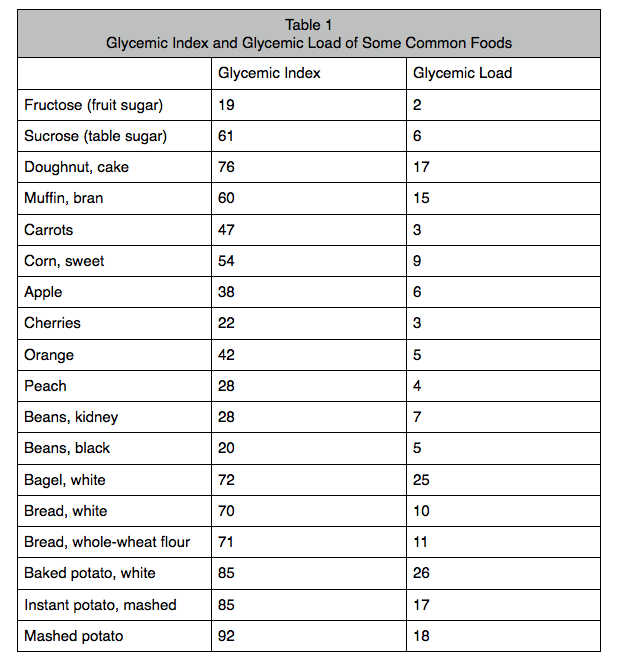
Simply put Glycemic Index is a number ranking given to a food based on how quickly it causes blood sugar to rise. Anything with an index above 60 is to be avoided. Glycemic Load means finding out the sugar impact of a combination of foods, like a meal. The base for the ranking is glucose, which has a Glycemic Index of 100 and glycemic load of 10. The load is based on the complexity of a carbohydrate and its fiber, fat or protein content.
Low Glycemic Load foods are those foods with a value of 10 or below; medium Glycemic Load foods are those foods with a value from 11 up to 19; high Glycemic Load foods are foods with a value of 20+. Since foods that are low in Glycemic Load are typically fruits and vegetables, whole grains, legumes, and lean proteins, a low Glycemic diet is a healthy, balanced diet.
Fruit sugar has an index of 19 and a load of 2 (fruit juice is substantially higher). Table sugar has an index of 61 with a load of 6. Some foods will surprise you. a fresh peach has a glycemic index of 22 and load of 3. Mashed potatoes have an index of 92 and a load of 18! Happily this doesn't mean that you must never eat mashed taters again.
The combination of foods and order in which they are eaten can absolutely bring that number down. For example, If you have a meal of turkey, a small portion of mashed potatoes and a bigger portion of broccoli or squash, the mashed taters won't spike your blood sugar the way they will if eaten first or without other foods. This has to do with the level of fat, protein, and fiber in that combination. This is why I always suggest that you add a good fat or protein to your snack. Many people think that this will make them put on weight. On the contrary, if portions are kept small, you will be surprised at how satisfied you become after only a small snack. With a little practice, you will learn how to manage any party or food buffet that comes your way without binging or being distracted by the tired feeling of overeating and feel really good!
Showing posts with label counting calories. Show all posts
Thursday, November 11, 2010
A Better Way to Manage a Meal
Labels:
blood sugar,
calorie,
counting calories,
foods,
fruit sugar,
glycemic,
Glycemic Load,
sugar
Friday, November 5, 2010
A Calorie is No Longer a Calorie
Many of us were raised counting calories. We bought calorie books and tried to calculate the amount on our plate only to find ourselves hungry shortly after the meal.
During the eighties new science began showing us that the method we were so comfortable with was becoming obsolete. Dr Jenkins' work published in the JAMA began to rock the diet world and flip the food pyramid. The great news is that we now know how to avoid weight and health problems better that our parents did, if we choose to use it.
For example we now understand that two foods with the same amount of calories my have very different effects on the body. A white bagel with fat free cream cheese and a caesar salad have the same amount of calories yet one will spike your blood sugar as quickly as a large candy bar. And that baked potato with fat free sour cream? Same as eating ice-cream. Want more? That fat free yogurt with fruit with that name brand tasty fat free health bar? Regarding the effect on blood sugar you may as well have a piece of apple pie for lunch.
Many of us are unknowingly eating this way several times a day, and becoming addicted to it. In his book, Healthy for Life, Dr. Ray Strand explains that when we become resistant to our own insulin "a calorie is no longer a calorie". Let me put it in a simple way. Our pancreas was not made to put out insulin at the rate our eating demands it. Insulin is a storage hormone. As we over-produce it after eating, the calories that should be used for energy are converted to belly fat. Then the process begins over again with cravings and more stored fat.
For the next two weeks we will discuss glycemic index and glycemic load. We will learn to begin using this to maintain mental clarity, lasting energy, reduce cravings, and move toward your perfect weight for a lifetime!
Won't that feel good?
During the eighties new science began showing us that the method we were so comfortable with was becoming obsolete. Dr Jenkins' work published in the JAMA began to rock the diet world and flip the food pyramid. The great news is that we now know how to avoid weight and health problems better that our parents did, if we choose to use it.
For example we now understand that two foods with the same amount of calories my have very different effects on the body. A white bagel with fat free cream cheese and a caesar salad have the same amount of calories yet one will spike your blood sugar as quickly as a large candy bar. And that baked potato with fat free sour cream? Same as eating ice-cream. Want more? That fat free yogurt with fruit with that name brand tasty fat free health bar? Regarding the effect on blood sugar you may as well have a piece of apple pie for lunch.
Many of us are unknowingly eating this way several times a day, and becoming addicted to it. In his book, Healthy for Life, Dr. Ray Strand explains that when we become resistant to our own insulin "a calorie is no longer a calorie". Let me put it in a simple way. Our pancreas was not made to put out insulin at the rate our eating demands it. Insulin is a storage hormone. As we over-produce it after eating, the calories that should be used for energy are converted to belly fat. Then the process begins over again with cravings and more stored fat.
For the next two weeks we will discuss glycemic index and glycemic load. We will learn to begin using this to maintain mental clarity, lasting energy, reduce cravings, and move toward your perfect weight for a lifetime!
Won't that feel good?
Labels:
blood sugar,
calorie,
calorie books,
counting calories,
diet,
glycemic,
insulin,
meal,
reduce cravings
Subscribe to:
Posts (Atom)
